
Plan a trip
Why Do Hyenas Laugh?
Last updated: April 2026
You hear it before you see them. A rising, cascading cackle in the dark — the sound that earned the spotted hyena its nickname. But the “laughter” of a hyena has nothing to do with amusement.
It is a sophisticated communication signal, one of more than a dozen distinct vocalisations in a hyena’s repertoire. Understanding what that sound actually means changes how you hear it entirely.
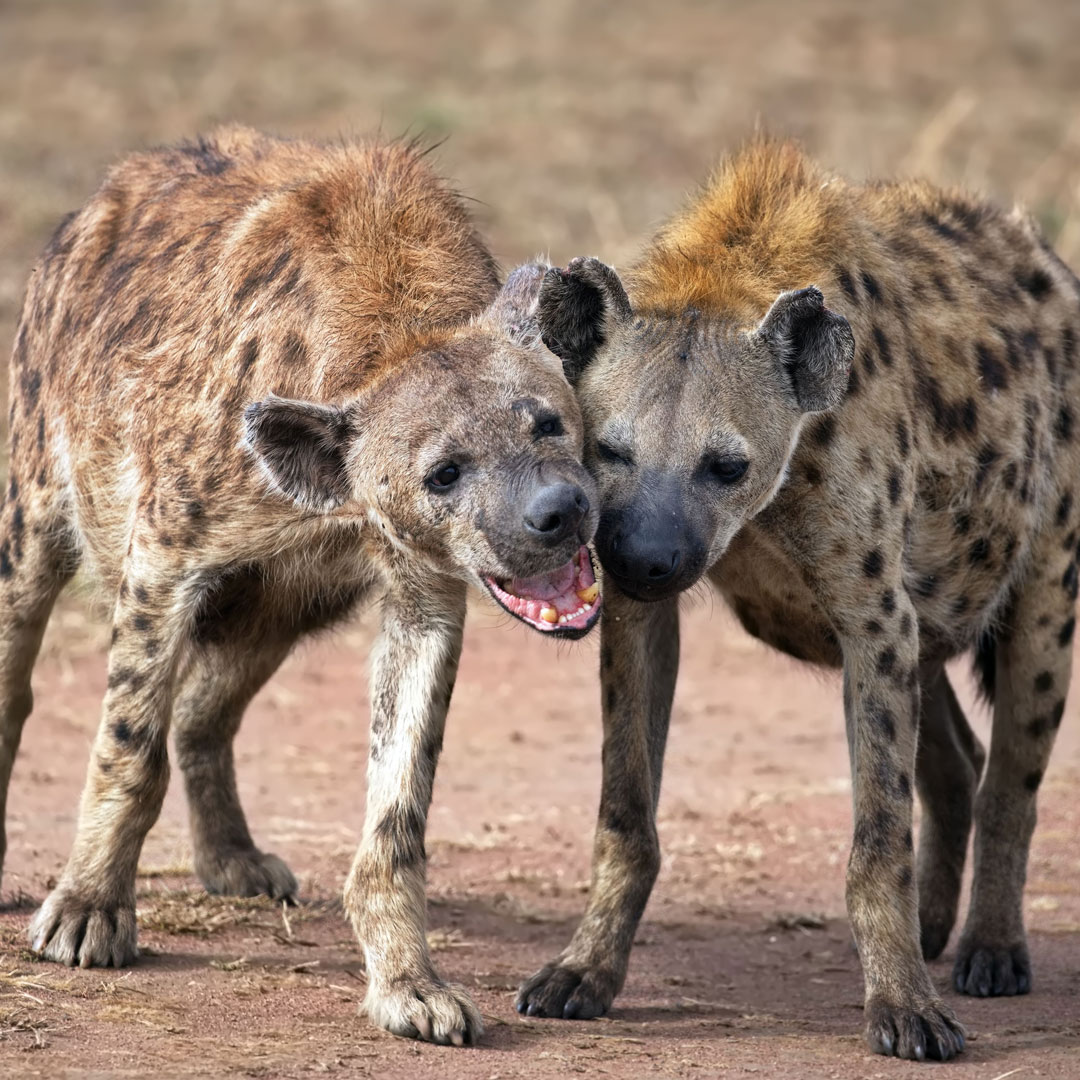
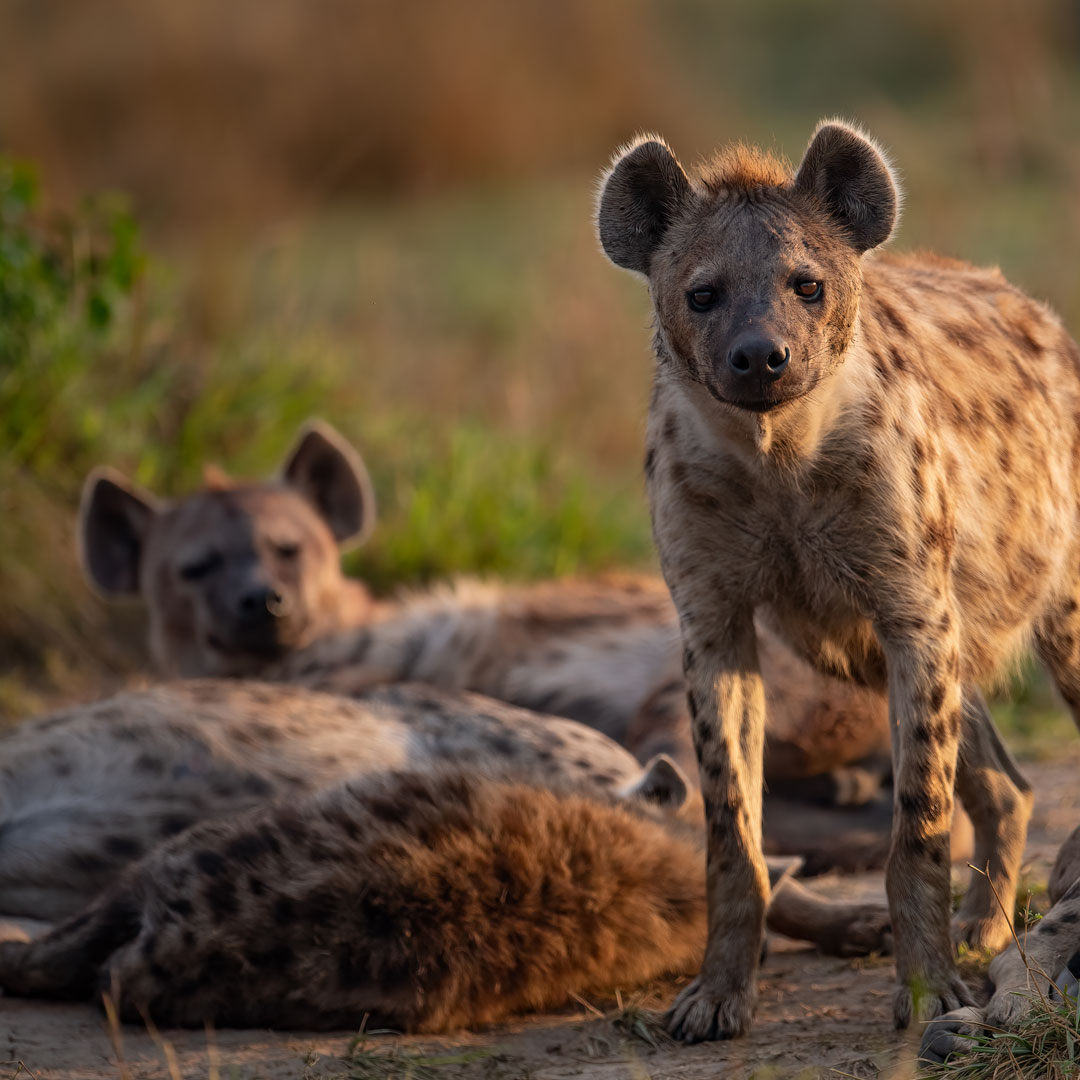
It’s Not Actually Laughter
The vocalisation we call “laughter” is technically a giggle — a rapid, high-pitched series of calls that rises and falls in pitch. Scientists who study spotted hyenas use the term “giggle” to distinguish it from the whoop, grunt, and groan that form other parts of the hyena’s communication system.
Hyenas do not giggle because they find something funny. The giggle is a communication tool, and what it communicates depends entirely on the context in which it is produced. The confusion is understandable: to a human ear, the sound is unmistakably laugh-like. But mapping human emotional categories onto animal vocalisations has led to decades of misunderstanding about what hyenas actually are.
What the Giggle Actually Means
The giggle is most commonly heard in high-stakes, high-energy situations. Research by Dr Frederic Theunissen and colleagues at UC Berkeley identified that the acoustic structure of the giggle carries information about the caller’s age, social rank, and emotional state. Contexts in which hyenas giggle:
- During feeding frenzies — competition over a carcass triggers rapid giggling between clan members
- When being chased or harassed by a dominant animal
- During submission to a higher-ranking individual
- In moments of high excitement, including the early stages of a hunt
- When separated from clan members and under stress
The giggle is not a happy sound. It signals excitement, stress or social tension — the opposite of the joyful connotation the human name implies.
The Full Hyena Vocabulary
Hyenas possess one of the most complex vocal repertoires of any carnivore. The giggle is one of at least fourteen distinct vocalisations that researchers have catalogued. Key calls include:
- Whoop — the long-distance contact call; carries up to 5km
- Giggle — social tension, excitement, submission
- Groan — greeting between clan members
- Grunt — used during social interactions and mild aggression
- Yell — alarm or pain response
- Fast whoop — used specifically to summon clan members to a kill
- Lowing — a low moaning call, often produced by cubs
Each call is not just a category but a variable signal — pitch, rate and duration carry additional information about the specific situation and the identity of the caller.
The Whooping Call
If the giggle is the most famous hyena sound, the whoop is the most powerful. The whoop is a long, rising call that carries across extraordinary distances — under the right atmospheric conditions, up to five kilometres.
Its primary function is long-distance communication between clan members who are separated. A hyena returning to a den after a long forage will whoop to announce its approach. A clan member that has made a kill will whoop to summon help. A lost cub will whoop for its mother.
Crucially, each individual hyena has a distinct whoop. Research has confirmed that spotted hyenas can identify specific clan members — and distinguish between clan members and strangers — based on call characteristics alone. This is individual recognition through sound.
What Vocalisations Tell Us About Intelligence
The complexity of hyena communication is not accidental. It reflects the demands of living in large, fluid, politically complex social groups. Spotted hyena clans of up to 80 individuals require every member to track relationships, alliances and hierarchies constantly. The vocal repertoire is the interface through which this social intelligence operates.
Species with simpler social lives have simpler vocal systems. The hyena’s communication complexity is a direct reflection of its cognitive investment in managing social relationships — the same investment that makes them outperform lions and leopards on problem-solving tasks.
Why Hyenas Are More Like Primates Than Dogs
Hyenas are classified in the order Carnivora, but their social and cognitive evolution more closely parallels primates than other carnivores. Spotted hyenas and primates independently arrived at similar social structures — large fission-fusion groups, individual recognition, complex dominance hierarchies maintained through coalition rather than constant aggression.
When researchers compare hyenas to lions, leopards and other carnivores on problem-solving and social cognition tests, hyenas consistently outperform them. The laugh you hear at night is not primitive. It is the sound of a highly intelligent social animal communicating with precision in the dark.
Ranger Buck Safaris offers close, guided encounters with spotted hyenas in the field. Come and hear what they are actually saying.
Hyena Conservation Library
Everything you need to understand hyenas — their biology, behaviour, threats, and the work being done to protect them.
- Hyena conservation efforts explained →
- How many hyenas are left in Africa? →
- Are hyenas endangered? →
- Why are hyenas important to the ecosystem? →
- Human–hyena conflict explained →
- Human–hyena conflict solutions →
- Spotted, striped and brown hyenas →
- Where to see hyenas in Africa →
- Is a hyena conservation experience ethical? →
- What do hyenas eat? →
- Why do hyenas laugh? →
- Are hyenas scavengers or hunters? →
- How strong is a hyena’s bite? →
- Hyena intelligence & behaviour →
- Hyena myths vs facts →
- Hyena social structure & clans →
- Are hyenas dangerous? →
- How hyenas are monitored →
- Hyena threats: poisoning & snaring →
- Hyenas vs lions →
- Hyena reproduction & cubs →
- Hyena habitat & range →
- Hyenas in African culture & folklore →
- Hyena conservation organisations →
- Hyena Conservation Experience →
get in touch with us
+27 83 653 5776
+27 83 653 5776 (WhatsApp)
info@rangerbucksafaris.com
16 Lourie Close, Meyersdal Eco Estate,
Alberton, Gauteng
16 Lourie Close, Meyersdal Eco Estate, Alberton, Gauteng

Website by Keeden Marketing | 2024
